
The Adamantine Platform™
an engineered-diamond interface platform designed to improve performance while enabling practical manufacturability and integration within existing industrial ecosystems. By addressing critical materials and packaging challenges, the company is helping establish new pathways for deploying engineered diamond across future semiconductor, optical, photonics, power electronic, and quantum applications. Backed by HAX/SOSV, DQ is advancing from platform validation toward customer qualification, pilot manufacturing and industrial deployment.
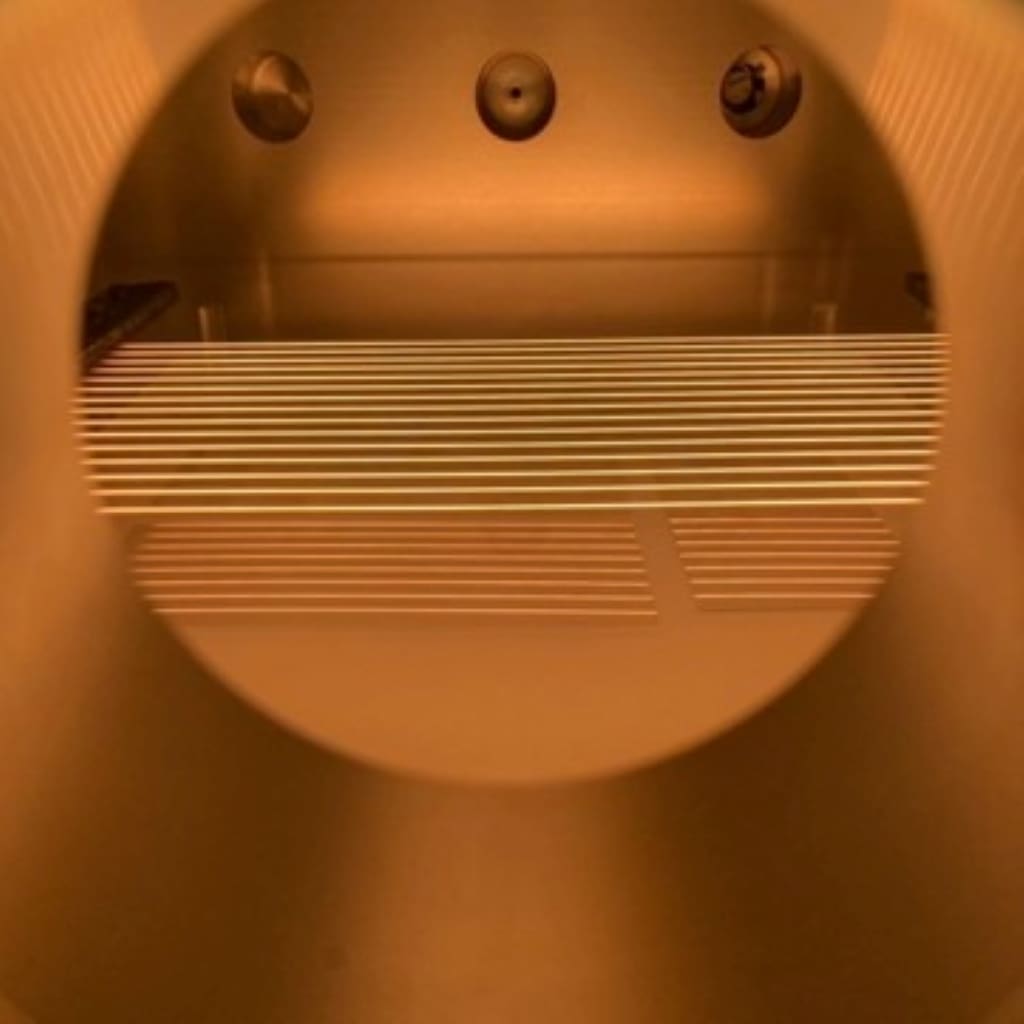
Best-In-Class Chemical Vapor Deposition
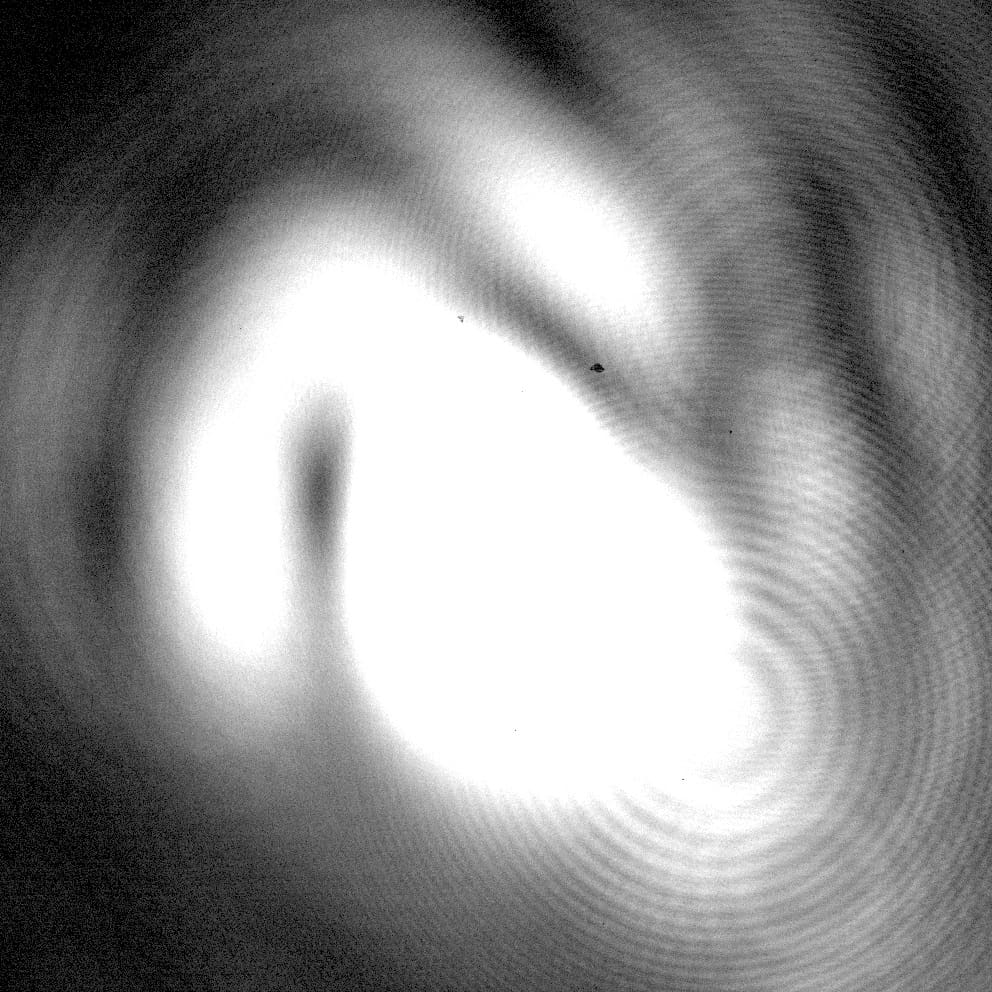
Defect-State Engineering and Densification via Pulsed-Laser Processing
Engineered diamond-integrated products for next-generation optics, semiconductor thermal solutions, and advanced packaging.
-
Adamantine Optics™: ultra-durable diamond optical coatings for displays and sensors
-
Adamantine Thermal™: high-performance diamond thermal solutions for advanced electronics
-
Scalable diamond coatings and substrates designed for integration and manufacturability
Adamantine Products Launched at CES 2026 Eureka Park
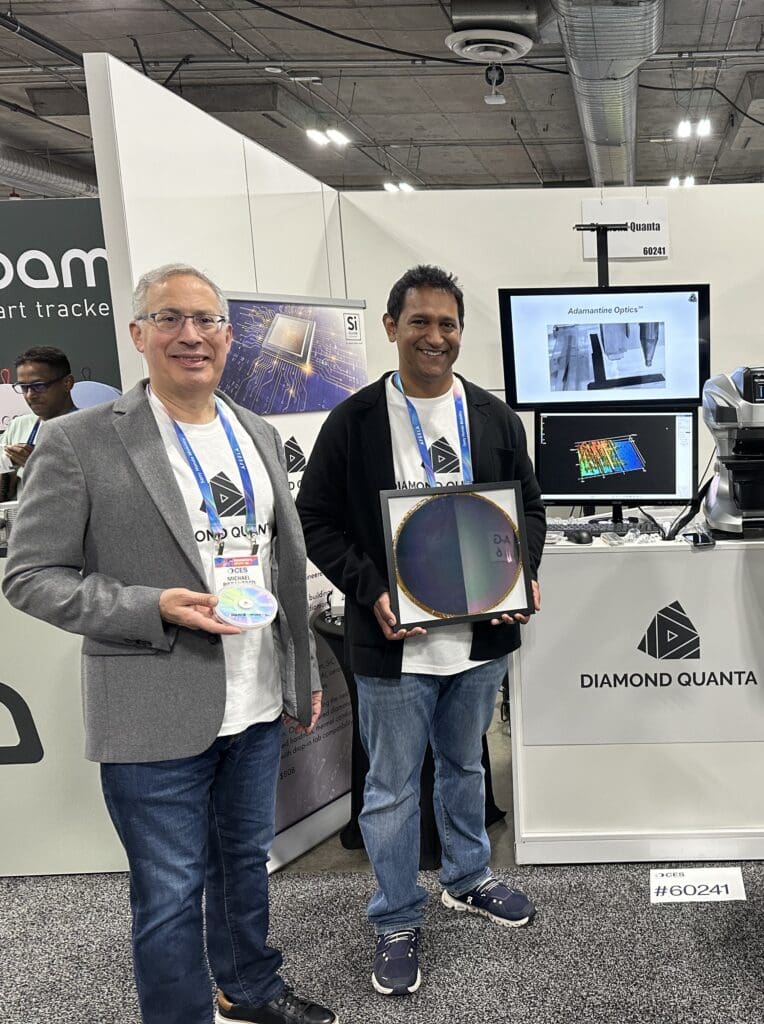
From the Venetian Expo Hall, attendees witnessed the launch of Diamond Quanta's Adamantine™ product lines.
Adamantine Optics™ debuted with a live head-to-head on real-world scratch test against a leading current market device using "diamond-like" surface.
Adamantine Thermal™ showcased our integrated diamond coating on 300mm wafer platform, highlighting new thermal interface solutions for Semiconductor.
CES® is a registered trademark of the Consumer Technology Association (CTA)®

Adamantine Optics™
Diamond Optics Built for Next-Generation Performance
- Utilizing DQ's propretiary stack & post-process modules, the resultant Antireflective (AR) composite features densified diamond (highest phase purity) and highest hardness (>40 GPa)
- Rugged optical coatings that resist wear, erosion, and abrasion
- Broadband Anti-Reflective + hardcoat stack for high transmission, low scatter & ultimate durability
- Maintains clarity under thermal and environmental stress
- Engineered for ruggedized display and lens, harsh-duty sensors, photonics, and optical windows

Adamantine Optics™ vs. Leading "Diamond-Like" Smartphone Display: Real-World Scratch Benchmark
Consumer touchscreens see mostly single-event, micro-ductile scratches. *Leading OEM field study reports that ~75% of observed events are micro-ductile and most fall in the 100–500 nm depth range. To mirror this use case, we ran a Taber linear abrasion using 150-grit garnet, 1 kg applied load, and one calibrated stroke, then quantified with optical profilometry. The reference “diamond-like” surface shows a continuous gouge with debris and secondary fines. Adamantine Optics shows only faint, instrument noise floor. Result: measured scratch depth and visible damage are suppressed below the common 100–500 nm micro-ductile band, which is the range that dominates real-world scratches.
*Souce: Price, J.J.; Xu, T.; Zhang, B.; Lin, L.; Koch, K.W.; Null, E.L.;Reiman, K.B.; Paulson, C.A.; Kim, C.-G.; Oh, S.-Y.; et al., Nanoindentation Hardness and Practical Scratch Resistance in Mechanically Tunable Anti-Reflection Coatings. Coatings 2021, 11, 213. https://doi.org/10.3390/coatings11020213
Leading “diamond-like” Smartphone Glass

Results: A continuous gouge with pile-up and micro-chips along the track. Numerous secondary micro-scratches visible across the field. Signature of plowing and brittle fracture under the real-world scratch conditions.
Adamantine Optics™ Diamond Stack

Results: No continuous groove. Only faint, shallow hairlines near instrument noise floor. Field remains uniform after the same real-world scratch run.


Measurements: Identical abrasive media, load, stroke, and cycle count across all samples. Post-test quantification by optical confocal profilometry (Keyence VR), leveled to best-fit plane; identical load, pass count, abrasive, and scan window for both samples.
Adamantine Thermal™
The platform leverages DQ’s 300mm CMOS-compatible diamond synthesis, laser-based densification, and wafer-to-wafer (W2W) and chip-to-wafer (C2W) bonding workflows to enable next-generation thermal interface materials, advanced packaging stacks, and diamond glass interposers.
- Effective thermal conductivity up to 5× Copper
Bond-ready diamond surfaces for packaging integration - Supports W2W/C2W workflows
- Target applications: power modules, AI accelerators, interposers, high-power RF modules

Adamantine Thermal™: Diamond-Integrated Thermal Solutions
Thermal control is a universal performance limiter in advanced electronics. Adamantine Thermal™ harnesses diamond’s world-leading thermal conductivity in engineered form factors compatible with advanced packaging and interposer architectures.
Key features:
- Diamond thermal spreading layers for hotspots and device arrays
- Thermal interface materials (TIMs) optimized for low impedance and high reliability
- Compatibility with W2W/C2W bonding workflows targeting 2.5D/3D integration
- Engineered for power electronics, AI accelerators, and glass interposers
High-resolution STEM analysis confirms that Adamantine Thermal™ produces a dense, conformal diamond interface at the nanometer scale, eliminating the interfacial voids and weakly bonded regions that typically limit thermal performance in conventional coatings. The observed continuous diamond–substrate contact supports efficient phonon transport across the interface, directly reducing thermal boundary resistance. This interfacial quality is essential for deploying diamond as a functional thermal layer in wafer-to-wafer (W2W) and chip-to-wafer (C2W) bonded stacks, as well as in diamond glass interposers, where thermal spreading, flatness, and long-term reliability must be achieved simultaneously. Adamantine Thermal™ products are designed to be manufacturable at scale and to integrate with standard semiconductor and packaging equipment.

Diamond film surface thermal map under applied heat flux

The diamond-coated surface exhibits a highly uniform thermal profile with minimal lateral temperature gradient, indicating efficient in-plane heat spreading within the diamond thin film. The suppressed hot-spot formation is consistent with high intrinsic thermal conductivity and low interfacial thermal resistance at the diamond–glass interface.
Glass substrate thermal map under identical thermal loading

The glass side shows pronounced thermal gradients and localized temperature variation, reflecting the significantly lower thermal conductivity of fused silica relative to diamond. Heat transport is diffusion-limited in the glass, resulting in steeper gradients and reduced lateral spreading.
Glass has rapidly gained adoption as an interposer and packaging material due to its excellent dimensional stability, low RF loss, smooth surfaces, and compatibility with large-area, panel-scale manufacturing. These attributes make glass attractive for advanced packaging, particularly in high-speed and heterogeneous integration architectures. However, glass remains thermally insulating, creating a growing mismatch between electrical performance and thermal management as power densities increase.
Integrating diamond directly onto glass addresses this limitation without sacrificing the benefits that make glass attractive in the first place. Diamond adds an ultra-high-conductivity thermal spreading layer that suppresses hot spots, evens thermal gradients, and improves package-level reliability. In diamond-glass interposers, the glass provides mechanical precision and signal integrity, while diamond supplies the thermal performance required for next-generation chiplets, power devices, and dense 2.5D/3D stacks.