
Industry Perspective: Why Diamond Could Define the 2030s Power Electronics Era
Diamond’s ultra-wide bandgap, record thermal conductivity, high breakdown field, and radiation hardness push voltage, current density, frequency, and junction temperature higher without exotic cooling.
From Gemstone to Semiconductor Platform
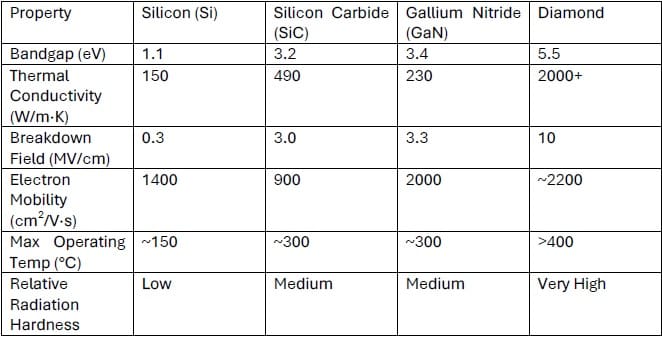
Advances in chemical vapor deposition (CVD) over the past decade have transformed diamond from a niche research material into a viable semiconductor substrate and thermal management solution. Its bandgap of 5.5 eV and thermal conductivity exceeding 2000 W/m·K make it superior to silicon carbide (SiC) and gallium nitride (GaN) in both high-temperature and high-power scenarios 1,2.
Dr. James Butler, a pioneer in diamond electronics at the U.S. Naval Research Laboratory, has described diamond as “the ultimate semiconductor material” for extreme environments 3. Its combination of wide bandgap, exceptional carrier mobility, and radiation hardness enables operation where other materials degrade from the searing heat of EV power inverters to the cold vacuum of space.
Material Property Comparison
Materials Landscape & Device Physics (Why diamond now)
Diamond Quanta recently published peer-reviewed results in MRS Advances (Feb 2025), demonstrating exceptionally high electron mobility ( >555 cm²/V·s) in polycrystalline diamond using a proprietary co-doping and defect engineering process. This establishes, for the first time, an electronics-grade polycrystalline diamond platform with performance once thought exclusive to single-crystal materials 12.
Synthetic diamond, grown via chemical vapor deposition (CVD), offers a set of properties unmatched by silicon, SiC, or GaN:
- Unparalleled Thermal Conductivity: Over five times higher than copper, enabling rapid heat extraction from densely packed power and logic devices.
- Wide Bandgap: At 5.5 eV, diamond supports high breakdown voltages and low leakage currents at elevated temperatures.
- Radiation Hardness: Ideal for aerospace and defense applications where reliability under high-radiation conditions is mission-critical.
- Mechanical Strength and Chemical Stability: Robust operation in aggressive environments such as jet engines or deep-space probes.
These traits position diamond as the ultimate semiconductor platform for high-power, high-frequency electronics operating in extreme conditions and higher temperature tolerance.
Thermal transport. Bulk CVD/single-crystal diamond exhibits room-temperature thermal conductivity near 2,000 W/m·K (isotopically enriched samples often >2,100 W/m·K) — an order of magnitude above AlN and ~5× copper. This enables much lower temperature rise for a given heat flux, directly extending safe operating area and switching frequency. By contrast, 4H-SiC is ~490 W/m·K and GaN is typically ~130–230 W/m·K.
